Hard to believe, but we’ve finally come to the end of my series on legendary Melbourne record label, Planet Records. The most recent instalment looked at the label’s impressive rock’n’roll legacy, but for this last hurrah, I’ll be picking up where I left off in the second episode, with some handy hints for aspiring record-label hot shots…and a cameo from Eartha Kitt .
Because even 55 years after the label folded, the Planet saga reads almost like a step-by-step guide on how to run an indie label, complete with a dramatic cautionary message thrown in. (And Eartha Kitt? Let’s just say any story is enhanced by her presence.)
Seize opportunities and weave PR magic
Bob King Crawford’s flair for promotion has been mentioned before in this blog, specifically in relation to the off-the-wall PR stunts and sci-fi back-story he dreamed up for those masked marauders, The Mystrys. By then, he was already an old hand at it, having learnt to play the media like a violin during the Planet years.
“Bob was way ahead of his time for promotion,” his Planet partner Marcus Herman recalls. “He really had a lot of ideas, when most Australian promoters didn’t have a clue.”
With Planet Records, Bob’s promo talents knew no limits. The notorious Elvis Presley record sleeve was covered in the previous post, but that’s just one example of many. My personal fave is how Bob leveraged a news story about infamous ufologist George Adamski, whose books Flying Saucers Have Landed and Inside the Space Ships were best-sellers in the 1950s, into publicity for the label. Adamski claimed to have been abducted by aliens and taken to Venus, so Bob wrote to him (alerting the media, naturally) suggesting that next time the aliens took him, perhaps George could ask if they’d be interested in recording some Venusian folk songs for release on Planet! The local press lapped it up.
 Not everybody shared the Royal family's positive reaction to Planet's stunts. As anyone remotely familiar with Melbourne history would know, demolition company Whelan the Wrecker gained notoriety in the 1950s and 60s for knocking down countless historic buildings around town in the name of, ahem, ‘progress’. This fact did not pass unnoticed at Planet HQ, and in early 1960, they released a single by a group called Whelan & the Wreckers (a name Bob bestowed upon them, naturally): ‘Hound Dog Man’ b/w ‘The Wreckers’.
While the A-side is a fun, upbeat little rocker (and can be heard on Youtube here), it was the B-side that whipped up the controversy they were aiming for. Sadly, I can’t find any audio of ‘The Wreckers’ online but legend has it the lyrics go something like this: We’re gonna tear down the buildings/rip up the floor/break up the joint/yell more more more
Mission accomplished: the director of Whelan the Wreckers called up threatening to sue Planet, both for defamation and for appropriating their name for rock’n’roll purposes. But Bob somehow convinced him that it was all good publicity, and no legal action was taken.
When one door closes, open another one (or the Spike Milligan story)
By now readers of the Planet Records story would be aware that the label never let its relatively small size limit its king-sized ambitions. An important lesson for any indie label (or indeed, anyone with a dream): why place restrictions on yourself, when so many others out there will be only too happy to throw obstacles your way?
And so, knowing that Irish-English comedian Spike Milligan’s parents lived in Woy Woy, north of Sydney (having migrated to Australia in 1951), and that Spike visited fairly frequently, Bob and Marcus somehow wrangled a meeting with the Goon when he was Down Under in the late 50s. The plan was for Planet to release a Spike Milligan comedy album.
“We went up there on a DC 3,” Marcus recounts (“a big deal for us!” Bob adds). “And we caught a taxi out to Woy Woy, to the house where he lived with his mum – it was a big expensive trip from Mascot. Which makes it all the more heartbreaking… Anyway, we’re there and we meet his delightful mum. It was sort of a narrow house with an upstairs, and she says, Spike will be down to see you soon; he’s looking forward to it.”
Mrs Milligan served them a cuppa and they all waited for the comedian to come downstairs…and waited…and waited.
Marcus continues: “So we’re looking at each other, and watching the time ticking by, and finally we ask Excuse me Mrs Milligan, but will he be down soon? And she says, I’ll just go and check. We can hear voices, but not what they’re saying. She comes back and says, He’ll be down soon. To cut a long story short, it went on and on like this. We had another cuppa –”
“We were starting to overflow by now!” exclaims Bob.
“-- then she goes upstairs again and comes back and says, I’ve got very bad news. Spike has changed his mind about the whole project. He did it all in that time we were there, the whole change of plan. So we took a taxi back again and went home.”
Neither Bob nor Marcus bore Milligan any grudges. “We never hated him for it,” Marcus reflects. “He was a terrific comedian: absolutely brilliant, very eccentric.” (As any Spike Milligan fan would know, the comedian battled bipolar disorder his whole life, possibly the reason behind his abrupt change of heart.)
Disappointed but not deterred, Marcus and Bob were still eager to release a comedy record. And it just so happened that American comedian Dave Barry came to town soon after (on the bill of one of Lee Gordon’s famous Big Shows, no less) and Marcus attended one of his performances.
“I saw him at the Festival Hall [then called the Stadium] – and thought he was brilliant,” Marcus says. When he told Bob about the show, “Bob said, Right, let’s do an album with him.” So they approached Barry, who agreed on the condition that he approve the recording first.
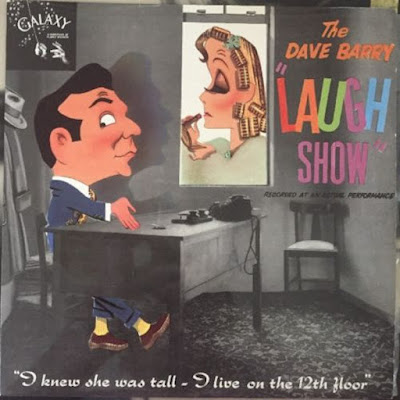
The Dave Barry Laugh Show is a live recording made at the Stadium, released on Planet subsidiary Galaxy in 1959. And best of all? It was a huge seller.
Be careful who you trust: the end of an era
For all Planet’s successes and innovations, its stable of stars and its prolific back catalogue, the label found itself in some financial difficulty by the late 50s after a couple of unfortunate business decisions. To add insult to injury, they learned that they’d soon have to find a new HQ, as the Eastern Market was slated for demolition to make way for the Southern Cross Hotel.
While the exact timing of what happened next is lost in the mists of time even for those who were there, it seems Planet’s new accountant suggested a promising solution: that the label become a subsidiary of a recording company called Telefil, based at the rear of St Kilda RSL (now the site of live music venue, Memo Music Hall), and solve its financial woes that way. After inspecting the premises and approving of the facilities, Planet relocated to their new home some time around April 1960.
Intriguingly, the listing for Memo on the Acland St Village website asserts that Bill Armstrong—best known as head honcho of the famed Armstrong Studios in South Melbourne—was Telefil’s sound engineer from 1961-1965. Although Bob and Marcus know him well from working in the same industry, neither have heard that before. Bob tells me that about 12 months after everything went down the tubes with Telefil, he returned to the premises to retrieve what Planet material was salvageable, and saw Armstrong there on that occasion, but didn’t get the impression it was a permanent arrangement.
On the contrary, Telefil sounds like some kind of dodgy brothers set-up, staffed by a hodge-podge
of distinctly non-musical types. Among its employees were a Trinidad-born Olympic sprinter, Mike Agostini (who passed away just last year, and whose obituary mentions nothing of his stint with the company); an avid Bex-drinking secretary, Mrs Kinnon; actress Bunney Brooke (who went on to star in notorious 70s soap, Number 96); and even a former Miss Victoria, whose contribution seems to have been purely aesthetic. Oh, and let’s not forget the semi-trained teenage sound engineer and a bloke with a steel plate in his head who was particularly sensitive to the full moon!
Intriguingly, long before they realised that they’d handed themselves over on a silver platter to a bunch of crooks, Bob and Marcus received a hint that perhaps things weren’t as rosy as they thought. Some readers may remember Marcus’s past life theory from the first post in this series; well, as he remarks about the following anecdote: “This is going back to the yoo-hoo-hoos of metaphysics…”
A message from beyond
When Planet was still riding the waves of success at its Eastern Market location, “we had two studios, and it was more than I could handle,” he says. To cope with this, they hired a fellow named Geoff Roberts to do custom jobs for people who came in off the street to record something for themselves—much like Elvis did at Memphis Recording Service before he was discovered. “We recorded lots of rock groups that weren’t released,” Marcus comments (To think who might have slipped under the radar…)
It just so happened that Geoff’s mother was a medium, who hosted the occasional special evening get-together. Marcus recalls, “Geoff said to us, My mum is a psychic and she’s going to have one of her famous dinners – would you like to come? And Bob, would you like to bring your wife Heather? We thought that would be great—we didn’t know what to expect and so…”
Bob picks up the story: “We’re sitting in his mother’s anteroom and suddenly, there’s this noise. [He hums, a drawn-out low sound] We thought, What the hell’s that? And Geoff says, It’s the…”
Marcus: “…entity…”
Bob: “…building up.” (Considering they’ve been friends practically since Adam was a boy, it’s no wonder Marcus and Bob have a tendency to complete each other’s sentences!)
Marcus continues. “The energy was building up. Next, Geoff’s mother starts clearing her throat [he makes a gross hacking noise to demonstrate]. We’ve all been placed in a circle: this is after we’d had something to eat and we were all sober as it wasn’t a boozy get-together. Anyway, his mother stands up and starts [makes hacking noise again]. Then this voice comes through—My friends!—it was like this deep amplified voice. A Red Indian speaking through his mother. So Geoff and his sister say, Hello Hookah; welcome, and Hookah said I have a message for everyone present. There were about 12 people including us.”
Apparently, Geoff’s mother’s spiritual abilities were well known in Melbourne. According to Marcus, “the Alfred Hospital did a check on her with her in a trance and said she was clinically dead”. Bob goes one better: “This woman was so good, the practitioners of the Alfred used to go to her to check out how to do operations!”
Who knows? The fact remains, she (or, rather, Hookah) knew Planet’s fate before Planet did.
Marcus explains: “Then Hookah said, You and you – pointing to the two of us –think you’re in a business with wonderful people. You think they’re so trustworthy but right at this very moment they’re – I can’t think of the exact words he used, but to the effect that they were taking us down. But we didn’t believe it, because one of the people in the company was a QC!”
The QC in question was Telefil’s main investor, Philip Opas QC, a high-profile sportsman and barrister (who later defended the last man hanged in Australia, Ronald Ryan, at his murder trial). Although his involvement gave the company a veneer of respectability, Opas had very little to do with Telefil’s day-to-day activities, so chances are he was as blissfully ignorant of its shortcomings as Bob and Marcus. Hookah, on the other hand…
“I’d been looking for something to confirm for me that there was more to life than what we perceive around us,” Marcus sighs.
Hookah was right: Planet’s brief time at Telefil was neither happy, nor productive. They released one LP while they were there (an album of football marches that Bob wrote in one night and recorded with the marching band the next day!), an EP and a couple of singles. Telefil showed no interest in promoting or distributing the records, or acting on ideas Bob and Marcus had for new releases. And one of the saddest things? The Bex-addled secretary, Mrs Kinnon, erased all Planet’s master tapes to resell as blank tape.
“There’s a little bit of sticky tape joining a leader in between the tracks: that’s the silence that gets put in between items. I’d always be editing those in," says Marcus. "Anyway, she comes to us and says: I’ve had a wonderful day today. You know those tapes of yours? I got young Russell to take out all those gaps, rejoin them, bulk-erase the lot on the magnetic bulk-eraser, and we’ve sold them for so much each tape.”
“Six dollars,” Bob recalls with disbelief.
Not surprisingly, Marcus resigned soon after. Bob stayed on for a few extra months: he now had a family to support, after his wife Heather gave birth to their son on Christmas Eve, 1960. (Something else Hookah the Indian spirit had predicted!)
When I remark that Mrs Kinnon single-handedly destroyed a piece of Australian history, Bob mentions that “When Telefil went under, I went down and collected what was there, put it all in the cab and took it home. So I’ve still got some.”
Turns out what he's got is second-best though. “He’s got stampers,” Marcus explains. “The stampers would be deteriorated for certain by now. By the same token, it’d be worth checking them out and giving them to one of the vinyl pressing places to see what they think. It’s still not the same as having the master tape.”

 Of course, you can’t keep a good studio mogul down, and both Bob and Marcus went on to further ventures. Marcus started Crest Records, on which he released some killer bands including The Blue Jays, The Frantics and The Leprechauns (the latter two later turning up on classic Kavern 7 comp, It’s a Kave-In).

 Meanwhile, Bob’s next move was his Talent City label, well known for its series of AFL 7” EPs—one for each team, complete with original, Crawford-composed, team-specific songs! And let’s not forget the ‘How to Speak Australian’ record by one ‘Bob K. Crawford: Head Lecturer on Physics, Philosophy, Football etc at the University Hotel’...

Anyway, in February 1969, the wondrous Eartha Kitt came to town, and was booked to perform at the Lido. “The first rehearsal she’s there, and her eyes smouldered,” Bob says. “They gave off a light like they were on fire, the most incredible eyes. She told the band off, told everyone off, got stuck in. Then she winked at me and said Always let everyone know who’s boss.”
Towards the end of Eartha’s stint, “David McIlwraith said, Take Eartha down to the accountants, because she’s got to get a taxation form so she can leave the country. So we grab a cab and we go down to the accountant. She’s got an ermine coat on, $100,000 worth, and she looks magnificent! So we walk in and the man says, Sit down, I’ll only be a second. And we sit, while he goes through his papers. We sit there for a while. Then Eartha gets up, takes off her coat, puts it on a chair, and walks across to the desk. This bloke’s very, very English: his whole attitude, the way he’s dressed, everything, and she walks across and she stands on her head on his desk!”
Bob found out the next day that the accountant had called McIlwraith to report that, “I looked at Crawford, and Crawford acted like it was something normal.” All in a day’s work for the King, after all…
That’s all, folks!
Of course, despite this being the fourth and final post in my series on Planet Records, I’ve barely scraped the surface. First step for anyone wishing to know more about this fascinating and multifaceted Melbourne label is to track down issues 130, 131 and 132 of Big Beat of the ‘50s magazine (published quarterly by the Australian Rock’n’Roll Appreciation Society), which cover Planet’s history in minute detail.
Bob King Crawford’s own website is also well worth a visit: prepare for sensory overload!
Huge thanks to Bob and Marcus for being so generous with their time and memories: it's been a blast, fellas!
Because even 55 years after the label folded, the Planet saga reads almost like a step-by-step guide on how to run an indie label, complete with a dramatic cautionary message thrown in. (And Eartha Kitt? Let’s just say any story is enhanced by her presence.)
 |
| Marcus Herman and Bob King Crawford at 'Vinyl from the Vault', a Melbourne Music Week session, recently, where Bob appeared as part of a discussion panel about the music industry |
So you want to start a record label? More interPLANETary guidelines for success
Seize opportunities and weave PR magic
Bob King Crawford’s flair for promotion has been mentioned before in this blog, specifically in relation to the off-the-wall PR stunts and sci-fi back-story he dreamed up for those masked marauders, The Mystrys. By then, he was already an old hand at it, having learnt to play the media like a violin during the Planet years.
“Bob was way ahead of his time for promotion,” his Planet partner Marcus Herman recalls. “He really had a lot of ideas, when most Australian promoters didn’t have a clue.”
With Planet Records, Bob’s promo talents knew no limits. The notorious Elvis Presley record sleeve was covered in the previous post, but that’s just one example of many. My personal fave is how Bob leveraged a news story about infamous ufologist George Adamski, whose books Flying Saucers Have Landed and Inside the Space Ships were best-sellers in the 1950s, into publicity for the label. Adamski claimed to have been abducted by aliens and taken to Venus, so Bob wrote to him (alerting the media, naturally) suggesting that next time the aliens took him, perhaps George could ask if they’d be interested in recording some Venusian folk songs for release on Planet! The local press lapped it up.
 |
| Artist Jim Nichols' impression of George Adamski meeting a Venusian (can't you just imagine what the Planet artwork would've looked like?) |
“That tied in with the name of the label, of course,” says Marcus. Indeed, the outer-space theme was evident everywhere from their slogan ‘If artists are out of this world, they’re on a Planet!’ to the label’s intergalactic presence at Melbourne’s annual Moomba Parade, where staff, friends and family would be roped in to masquerade as extraterrestrials!
Then there was the ‘Royal Baby Waltz’, composed by Bob, narrated by someone called Douglas Kelly, performed by Planet regular Barry O’Dowd and the Bruce George Ensemble, and released on the day Prince Andrew was born in 1960. Of course, nobody knew what sex the baby would be, so two versions of the song were prepared: one for a prince and one for a princess. Apparently the Royal family was most impressed, with the Governor-General sending a letter of congratulations to Planet on their behalf. |
| The Planet team at Moomba . Note the cheeky sign: 'We admit that American artists are nearly as good'! |

While the A-side is a fun, upbeat little rocker (and can be heard on Youtube here), it was the B-side that whipped up the controversy they were aiming for. Sadly, I can’t find any audio of ‘The Wreckers’ online but legend has it the lyrics go something like this: We’re gonna tear down the buildings/rip up the floor/break up the joint/yell more more more
Mission accomplished: the director of Whelan the Wreckers called up threatening to sue Planet, both for defamation and for appropriating their name for rock’n’roll purposes. But Bob somehow convinced him that it was all good publicity, and no legal action was taken.
When one door closes, open another one (or the Spike Milligan story)
By now readers of the Planet Records story would be aware that the label never let its relatively small size limit its king-sized ambitions. An important lesson for any indie label (or indeed, anyone with a dream): why place restrictions on yourself, when so many others out there will be only too happy to throw obstacles your way?
And so, knowing that Irish-English comedian Spike Milligan’s parents lived in Woy Woy, north of Sydney (having migrated to Australia in 1951), and that Spike visited fairly frequently, Bob and Marcus somehow wrangled a meeting with the Goon when he was Down Under in the late 50s. The plan was for Planet to release a Spike Milligan comedy album.
 |
| The house Spike Milligan's mum used to live in (photo: Google Earth) |
Mrs Milligan served them a cuppa and they all waited for the comedian to come downstairs…and waited…and waited.
 |
| Spike Milligan as Batman, just because |
“We were starting to overflow by now!” exclaims Bob.
“-- then she goes upstairs again and comes back and says, I’ve got very bad news. Spike has changed his mind about the whole project. He did it all in that time we were there, the whole change of plan. So we took a taxi back again and went home.”
Neither Bob nor Marcus bore Milligan any grudges. “We never hated him for it,” Marcus reflects. “He was a terrific comedian: absolutely brilliant, very eccentric.” (As any Spike Milligan fan would know, the comedian battled bipolar disorder his whole life, possibly the reason behind his abrupt change of heart.)
Disappointed but not deterred, Marcus and Bob were still eager to release a comedy record. And it just so happened that American comedian Dave Barry came to town soon after (on the bill of one of Lee Gordon’s famous Big Shows, no less) and Marcus attended one of his performances.
“I saw him at the Festival Hall [then called the Stadium] – and thought he was brilliant,” Marcus says. When he told Bob about the show, “Bob said, Right, let’s do an album with him.” So they approached Barry, who agreed on the condition that he approve the recording first.
The Dave Barry Laugh Show is a live recording made at the Stadium, released on Planet subsidiary Galaxy in 1959. And best of all? It was a huge seller.

Be careful who you trust: the end of an era
For all Planet’s successes and innovations, its stable of stars and its prolific back catalogue, the label found itself in some financial difficulty by the late 50s after a couple of unfortunate business decisions. To add insult to injury, they learned that they’d soon have to find a new HQ, as the Eastern Market was slated for demolition to make way for the Southern Cross Hotel.
While the exact timing of what happened next is lost in the mists of time even for those who were there, it seems Planet’s new accountant suggested a promising solution: that the label become a subsidiary of a recording company called Telefil, based at the rear of St Kilda RSL (now the site of live music venue, Memo Music Hall), and solve its financial woes that way. After inspecting the premises and approving of the facilities, Planet relocated to their new home some time around April 1960.
 |
| Melbourne live music fans would know this venue well: Telefil was in the rear |
On the contrary, Telefil sounds like some kind of dodgy brothers set-up, staffed by a hodge-podge
 |
| Bunney Brooke. I vaguely remember her from E-Street |
Intriguingly, long before they realised that they’d handed themselves over on a silver platter to a bunch of crooks, Bob and Marcus received a hint that perhaps things weren’t as rosy as they thought. Some readers may remember Marcus’s past life theory from the first post in this series; well, as he remarks about the following anecdote: “This is going back to the yoo-hoo-hoos of metaphysics…”
A message from beyond
When Planet was still riding the waves of success at its Eastern Market location, “we had two studios, and it was more than I could handle,” he says. To cope with this, they hired a fellow named Geoff Roberts to do custom jobs for people who came in off the street to record something for themselves—much like Elvis did at Memphis Recording Service before he was discovered. “We recorded lots of rock groups that weren’t released,” Marcus comments (To think who might have slipped under the radar…)
 |
| Bob with his towering pile of scrapbooks |
It just so happened that Geoff’s mother was a medium, who hosted the occasional special evening get-together. Marcus recalls, “Geoff said to us, My mum is a psychic and she’s going to have one of her famous dinners – would you like to come? And Bob, would you like to bring your wife Heather? We thought that would be great—we didn’t know what to expect and so…”
Bob picks up the story: “We’re sitting in his mother’s anteroom and suddenly, there’s this noise. [He hums, a drawn-out low sound] We thought, What the hell’s that? And Geoff says, It’s the…”
Marcus: “…entity…”
Bob: “…building up.” (Considering they’ve been friends practically since Adam was a boy, it’s no wonder Marcus and Bob have a tendency to complete each other’s sentences!)
Marcus continues. “The energy was building up. Next, Geoff’s mother starts clearing her throat [he makes a gross hacking noise to demonstrate]. We’ve all been placed in a circle: this is after we’d had something to eat and we were all sober as it wasn’t a boozy get-together. Anyway, his mother stands up and starts [makes hacking noise again]. Then this voice comes through—My friends!—it was like this deep amplified voice. A Red Indian speaking through his mother. So Geoff and his sister say, Hello Hookah; welcome, and Hookah said I have a message for everyone present. There were about 12 people including us.”
Apparently, Geoff’s mother’s spiritual abilities were well known in Melbourne. According to Marcus, “the Alfred Hospital did a check on her with her in a trance and said she was clinically dead”. Bob goes one better: “This woman was so good, the practitioners of the Alfred used to go to her to check out how to do operations!”
Who knows? The fact remains, she (or, rather, Hookah) knew Planet’s fate before Planet did.
Marcus explains: “Then Hookah said, You and you – pointing to the two of us –think you’re in a business with wonderful people. You think they’re so trustworthy but right at this very moment they’re – I can’t think of the exact words he used, but to the effect that they were taking us down. But we didn’t believe it, because one of the people in the company was a QC!”
The QC in question was Telefil’s main investor, Philip Opas QC, a high-profile sportsman and barrister (who later defended the last man hanged in Australia, Ronald Ryan, at his murder trial). Although his involvement gave the company a veneer of respectability, Opas had very little to do with Telefil’s day-to-day activities, so chances are he was as blissfully ignorant of its shortcomings as Bob and Marcus. Hookah, on the other hand…
“I’d been looking for something to confirm for me that there was more to life than what we perceive around us,” Marcus sighs.
 |
| Older and wiser... |
Hookah was right: Planet’s brief time at Telefil was neither happy, nor productive. They released one LP while they were there (an album of football marches that Bob wrote in one night and recorded with the marching band the next day!), an EP and a couple of singles. Telefil showed no interest in promoting or distributing the records, or acting on ideas Bob and Marcus had for new releases. And one of the saddest things? The Bex-addled secretary, Mrs Kinnon, erased all Planet’s master tapes to resell as blank tape.
“There’s a little bit of sticky tape joining a leader in between the tracks: that’s the silence that gets put in between items. I’d always be editing those in," says Marcus. "Anyway, she comes to us and says: I’ve had a wonderful day today. You know those tapes of yours? I got young Russell to take out all those gaps, rejoin them, bulk-erase the lot on the magnetic bulk-eraser, and we’ve sold them for so much each tape.”
“Six dollars,” Bob recalls with disbelief.
Not surprisingly, Marcus resigned soon after. Bob stayed on for a few extra months: he now had a family to support, after his wife Heather gave birth to their son on Christmas Eve, 1960. (Something else Hookah the Indian spirit had predicted!)
When I remark that Mrs Kinnon single-handedly destroyed a piece of Australian history, Bob mentions that “When Telefil went under, I went down and collected what was there, put it all in the cab and took it home. So I’ve still got some.”
Turns out what he's got is second-best though. “He’s got stampers,” Marcus explains. “The stampers would be deteriorated for certain by now. By the same token, it’d be worth checking them out and giving them to one of the vinyl pressing places to see what they think. It’s still not the same as having the master tape.”
Of course, you can’t keep a good studio mogul down, and both Bob and Marcus went on to further ventures. Marcus started Crest Records, on which he released some killer bands including The Blue Jays, The Frantics and The Leprechauns (the latter two later turning up on classic Kavern 7 comp, It’s a Kave-In). Meanwhile, Bob’s next move was his Talent City label, well known for its series of AFL 7” EPs—one for each team, complete with original, Crawford-composed, team-specific songs! And let’s not forget the ‘How to Speak Australian’ record by one ‘Bob K. Crawford: Head Lecturer on Physics, Philosophy, Football etc at the University Hotel’... Epilogue: the Eartha Kitt episode
OK, so this has nothing to do with Planet, but hell, it’s a cool little anecdote that’s too good not to share. Several years after Planet Records folded, and after his stint writing songs for The Mystrys, Bob King Crawford ended up doing PR for the Lido Theatre Restaurant, a glamorous (and saucy) ‘continental-style’ venue with showgirls and live musical performances, run by a fellow called David McIlwraith.
 |
| How good are these Lido posters? (Taken from Bob's own website) |
Bob’s illustrious track record of attracting attention must’ve preceded him. “At one stage, there were three people doing PR [for the Lido]; they all got fired and I was instated,” he recalls. A role promoting a venue famed for its razzle dazzle and leggy glamazons in various states of undress? Strangely enough, Bob accepted the job offer…
Anyway, in February 1969, the wondrous Eartha Kitt came to town, and was booked to perform at the Lido. “The first rehearsal she’s there, and her eyes smouldered,” Bob says. “They gave off a light like they were on fire, the most incredible eyes. She told the band off, told everyone off, got stuck in. Then she winked at me and said Always let everyone know who’s boss.”
 |
| Who's the boss, boys? |
Bob found out the next day that the accountant had called McIlwraith to report that, “I looked at Crawford, and Crawford acted like it was something normal.” All in a day’s work for the King, after all…
 |
| If she could do this, a headstand was nothin'. |
That’s all, folks!
Of course, despite this being the fourth and final post in my series on Planet Records, I’ve barely scraped the surface. First step for anyone wishing to know more about this fascinating and multifaceted Melbourne label is to track down issues 130, 131 and 132 of Big Beat of the ‘50s magazine (published quarterly by the Australian Rock’n’Roll Appreciation Society), which cover Planet’s history in minute detail.
Bob King Crawford’s own website is also well worth a visit: prepare for sensory overload!
Huge thanks to Bob and Marcus for being so generous with their time and memories: it's been a blast, fellas!


