Long time no post, dear readers, and I'm afraid that's not changing any time soon. Life is always getting in the way, and until I can kick my chronic overcommitment tendencies, this blog is on indefinite hiatus. Having said that, if anyone wants to get in touch with an idea for a post or an interview, or simply wants to tell me how much they miss my posts (!!), I can be reached via the email in my profile. Hopefully, I'll be back in Holy go-go boots land soon... Thanks for reading and stay groovy!
"Like most workers we managed to get away from the office at 5.30 p.m. Imagine the scene: a large room, lavatory-like atmosphere, filled with pushing men, no seats, no tables, everything stripped for action. There is a large clock on the wall, invariably set fast, because the police come around at 6 p.m.
"There is a big staff on for swill time: skilled barmen and barmaids, all equipped with the latest pluto taps on plastic hoses, designed for dispensing beer at frightening speed. Time moves past so quickly. It is twenty to six, now ten to six, the bar is 10-deep with crushing bodies, all thrusting handfuls of glasses towards the barmaids: 'Here', 'Here', 'For Chrissake here!' It is like penetrating the crowd behind the goals at a football match. Getting the precious cargo back to your possie is incredibly hazardous. Your mates help, of course, and you try to pass the glasses overhead. Beer rains."
Keith Dunstan, describing the ‘six o’clock swill’ at a Melbourne pub in the 1960s When I first visited Melbourne on holiday in the 90s, I was gob-smacked to discover that there were one or two establishments where you could buy booze around the clock. As in 24 hours a day. For a Perthie like myself, at the height of her gleefully irresponsible drinking days, this seemed like some amazing sci-fi Utopia. Little did I know then that my home state had its own alcohol-related claim to fame: resisting the temperance movement’s push for heavily restricted pub opening hours early last century, even as most other states around the country fell into line with a supposedly more civilised six-o’clock closing time. Victoria was one of the first states to start closing its pubs early, in 1916—and one of the last to return to later opening hours. It wasn’t until February 1966 that Victoria reinstated the 10pm closing time, ending the notorious phenomenon known as the six o'clock swill more than 10 years after its perennial rival New South Wales (and almost 30 years after Tasmania!).
Swill time at an unidentified Melbourne pub. Look at that smashed old codger to the right!! (Photo: Herald Sun.)
These days, a night out at the pub with your mates is practically a sacred tradition in Melbourne, where there’s a pub to cater for every kind of punter—from hipsters to bar-flies, families to foodies, sports nuts to rock’n’roll fans—which makes it hard to process the fact that the city was once so far behind the curve when it came to licensing laws. And this in a decade when it led the country in so many other respects.
More Melbourne swilling. Who'd be a barmaid? (Photo: Herald Sun)
Meanwhile, pub-goers continued spewing out (spewing being the operative word) into the city’s early-evening streets until 1966, in what journalist Reg Leonard called a “daily demonstration of piggery”.
Not quite the Prohibition (but not pretty, either)
As the opening quote from local journalist Keith Dunstan* describes so vividly, the six o’clock swill occurred when men would rush straight to the pub after work to knock back as many beers as they could stomach in the hour or so before closing time. Not surprisingly, the consequences of all these pushing, shoving hordes sculling beer like it was about to go extinct were a little unsavoury!
“At 6.15 p.m. we are all out on the footpath. Two characters over yonder are chundering into the gutter. Constitutions that have not known food for five hours need to be strong to handle five beers in 20 minutes.”
So much for temperance and moderation. The six o’clock swill was an excuse for high-speed, drunken debauchery.
Civilised sipping
Of course, people's tippling options weren’t completely cut off once the clock struck six. Folks could drink in restaurants, on the sly in some Italian-run cafes, and – if these gorgeous photos are anything to go by – in hotel cocktail bars.
Drinks at the Bar, Savoy Plaza Hotel, Spencer Street, Melbourne, 1965. Photo: Wolfgang Sievers
Cocktail bar at Menzies Hotel, Melbourne, Australia, 1965. Photo: Wolfgang Sievers (copyright NLA)
Note the presence of women in these pics: being banned from drinking in pubs around Australia until the 1970s (except in specially designated ‘ladies’ lounges,’ and only then if they were accompanied by a man...unless they were willing to risk their reputation), they clearly found other ways to partake.
So groovy! Cocktail bar of the Southern Cross Hotel (not sure who the photographer was)
Liquor-free live music
Although pubs are one of the main places to catch a band in Melbourne nowadays, this has only been a thing since the 1970s (the golden era of pub rock). Back in the 60s, gig-going was a teetotal experience, with bands performing in wholesome suburban town halls and unlicensed clubs. As inconceivable as this sounds now, I reckon it would've been fine. I mean, who needs booze when you’re being treated to acts like The Spinning Wheels, The Pink Finks, Normie Rowe, The Mystrys, The Strangers et al? I suppose some punters might’ve smuggled hipflasks in, or done their drinking beforehand (or indulged in another kind of intoxicant), but hell, the music itself would’ve been like a contact high!
The Spinning Wheels were busy! (ads taken from an old copy of The Livin' End)
More booze-free good times
Post script No system is perfect, of course, and extended drinking hours at pubs and clubs have been linked to a spate of horrifying late-night coward-punch attacks in recent years. Fact is, Australia’s had a chequered relationship with liquor since the earliest days of European settlement, when rum was traded as currency. But with Aussies’ booze consumption currently on a downward trajectory, maybe the problem will solve itself? *(Incidentally, in 1968 Dunstan authored the tellingly-titled book, Wowsers: being an account of the prudery exhibited by certain outstanding men and women in such matters as drinking, smoking, prostitution, censorship and gambling)
Following Part One of this series, which was really more of a prequel, we come to the action-packed hey-day of Planet Records, the country’s first record label dedicated to all-Australian talent. Once again, the stars of the show are the label’s founders Bob King Crawford and Marcus Herman...
Remember these two? Bob (L) and Marcus (R) pose with a Planet record
Missed part 1? Catch up here. This instalment won’t make much sense otherwise. What’s especially striking about the story of Planet Records is that even now, 55 years after the label folded, it reads like a step-by-step guide for aspiring independent record labels. Which is why it seems apt to name this post…
So you want to start a record label? An interPLANETary guide to success, steps 1-6
1) Define your point of difference Around the time of Planet’s rebirth, Bob King Crawford is quoted in an article as saying “I know what Australian artists can do. All they need is encouragement and this company aims to give them that.” By focusing solely on home-grown performers, Planet established its niche from the get-go, setting itself apart from majors such as Festival Records and EMI Australia, both of which released a lot of overseas talent in addition to local artists. In another newspaper story from the time, the Planet policy is defined even more clearly: “No artist is recorded who is not an Australian, a naturalised Australian, or, if British, has not lived in this country for two years.” And just in case any room for doubt remained, Planet record covers were emblazoned with the words ‘Proudly made in Australia.’ As Marcus Herman says, “We both had a terrific urge to make Australian stuff that was as good as, or better than, anything else.”
Like every other Planet release, this Trailblazers record was 'Proudly made in Australia'
2) Have faith in yourself and others will too A cursory glance at Bob King Crawford’s personal website says it all: this is one man who’s never suffered a moment of self-doubt in his life. Without such confidence propelling it, Planet Records may not have got off to the flying start it did. Its two young founders knew they were destined for greatness, but how did they convince others give them a go? To launch the label, Bob and Marcus decided an album of famous movie themes would be a sure-fire hit — especially if these themes were performed by popular local entertainer Stanfield Holliday on the prestigious Regent Theatre’s in-house Wurlitzer organ. Easier said than done.
The Regent Theatre's mighty Wurlitzer!
Somehow, this pair of untried entrepreneurs needed to convince the theatre’s management to let them set up their recording equipment on-site and cut a record. Says Bob: “Here we are with no real experience of anything but our own expertise, and we go to the manager of Hoyt’s Theatres [which owned the Regent]…and we talk them into letting us record their organ!” “Which was a big decision for them in those days,” adds Marcus. “We were such a small company.” Small in size, maybe, but big in bravado. The result, a 10” LP called Themes from the Films, was a hit when it was released in the second half of 1954. Planet was back in orbit!
3) Choose the right artists Let’s face it: Stanfield Holliday looks like a big old square, judging by the Themes from the Films covers. But the next Planet artist had considerably more ‘star quality’. Kenny Arnott was -- wait for it -- a hillbilly from Horsham. A self-taught guitarist who played his instrument upside-down and left-handed, Kenny was about 17 when he hit Melbourne-town in 1954, and soon gained a following as a result of his live performances and the radio show he hosted on station 3AK. Of course, as explained in the first instalment, the inspiration for Bob’s decision to resurrect Planet was his belief that Australian audiences would enjoy hearing country music performed by local artists. And who better to test his theory than this teenage sensation?
Unfortunately, it’s all but impossible to track down any of the songs from Hillbilly Classics to listen to (a common problem with Planet Records releases), but take a look at this spectacular cover and tell me you wouldn’t buy it based on that alone! I’m not even a country-music fan, but I love the sepia-toned photo of Kenny all decked out in his finery, serenading a (seemingly ambivalent) dog under a tree. The bright yellow rope-lettering is fabulously old-school, and the Planet logo in the top left-hand corner seems oddly appropriate, given that the photo appears to have been taken at night. Recorded in December 1954, Hillbilly Classics was, according to Bob, the first album in the world to have a full picture cover. The back cover was also put to good use, featuring informative liner notes about the artist plus details about the recording – something that no other labels bothered doing in those days.
Another (unofficial) world record set in the making of this album was the fact that it was recorded in what Bob described at the time as the “smallest studio in the world”: the hallway of Marcus’s parents’ house in Glen Iris!
Hillbilly Classics sold about 10,000 copies, a huge quantity for the era. It also launched what would be a long and prolific relationship between Planet and the handsome Horsham hillbilly.
When was the last time you saw someone smoking on their album cover?
...or sitting in a tree, playing left-handed guitar?
Besides going on to become a big Planet star, Kenny Arnott was inducted to the Australian Country Music Hall of Fame in 1988.
4) Be innovative Concentrating solely on local artists when nobody else was — being first in the world to use photo sleeves — many independent record labels would feel content to rest on their laurels by now, but not Planet. In fact, if this was a late-night TV advertorial, someone would be exclaiming ‘But wait, there’s more!’ right about now. Unlike a late-night TV advertorial, however, what Planet came up with next was a damn sight more exciting than a free set of steak knives: it was a revolutionary recording technique invented by Marcus Herman known as the Marco Process. Developed by Marcus because “there was a limit to how far the recording could go,” the Marco Process gave Planet the ability to fit more music on a record – without compromising the sound quality or tone. So instead of squeezing four tracks onto a 7” record (if they were lucky), they were now able to fit six: all sounding pristine.
On the back it says, Microgroove 45rpm, extra extended play
Asked to explain the technicalities behind the process in layperson’s terms, Marcus obliges: “Technically for one reason it was to make anything that had an automatic cut-off not to cut off prematurely before the track had finished. I worked out a way of getting the grooves closer together and equalising or reshaping the grooves on certain frequencies so that it wouldn’t break into the next groove. So that was really what it was all about.” Right then. I assume someone out there understands that! Still, even the most technologically challenged numpties among us can appreciate what a massive leap forward this represented for the recording industry in general. So how long did it take Marcus to perfect? Six months? A year? Try one week. “Today, that wouldn’t be anything,” he remarks modestly. “Because everything’s known about how to work with audio. But just the fact that I was the first to think it up…” Needless to say, once the major players in the industry got wind of Marcus’s invention, they were falling over themselves to acquire it. Phillips even offered him ₤10,000, only for him to turn them down and take off on holiday, leaving the media gob-smacked in his wake.
Clipping from one of Bob King Crawford's innumerable scrapbooks
“I was on holiday and Bob rang me up to tell me, The Herald cars are going around with you on banners on the side saying ‘Recording Engineer Goes on Holiday after Being Offered 10,000 Pounds!’ That would have bought me a home and set me up as a youngster. But I would’ve had to agree to never do anything for anybody else, Today it’d be called restricted or something else [restraint of trading laws?] but back then we could make any deal at all. Rightly or wrongly, I said no.” “Basically you were keeping it for Australian talent,” Bob reminds him. Indeed, in the article pictured above, Bob declares: “We feel this new development will give us the chance we’ve been waiting for to make a dent in the Australian record business. For the present we will hold it exclusive to Australian artists and use it to help sell Australian talent to the Australian public.”
5) Work hard, have fun and don’t waste time
During Planet’s first few years, Bob and Marcus worked like Trojans from their Tooronga Road HQ (ie the Herman family home) to establish the label. They’d get the important stuff done during the day, have dinner with Marcus’s parents, then concentrate on more menial tasks (like sticking tax labels on records) into the night.
Says Marcus: “Sometimes we’d work up until about 1 or 2 in the morning. Mum and Dad wanted Bob to stay over when we did those late nights but Bob was very strict about wanting to go home. Yet he’d always make his deadlines the next day regardless of how late it was.”
Far from finding it a drag, they loved every minute of it. “It was great fun!” Bob remembers fondly. “It was fantastic! We laughed and laughed.”
“Producing things and being so involved with them – that gave you a good feeling too,” Marcus says. “The last thing Bob and I ever seemed to think about was the money. Just the fact that it was all working.”
Just another day in the studio for baby Bob Crawford!
This sense of fun and passion for their work filtered through to their recording sessions, as Bob describes here:
“It worked this way: we had a three-hour call. First hour: lots of fun, lots of laughter, great. Second hour: a little bit more serious, Third hour: very serious! But sometimes we’d do a whole LP within three hours. We had no money. A three-hour call was a three-hour call.”
Clearly Bob's work ethic didn't change post-Planet
“I can recall so many of the artists saying You guys relax us, we’re never as relaxed as this normally,” says Marcus.
“While they were lying on the floor!” adds Bob, laughing.
This efficient system of having fun while working fast served them well: according to Bob, the whole turnaround time between recording and release occurring within a couple of months. “We had no option. We had to make a recording, get it out and get sales, because we financed ourselves – we had no-one else financing us.”
No wonder Planet was so prolific! According to an article in Big Beat of the Fifties magazine, they released about 40 7” EPs between 1955 and 1961 – and that’s before we even get to the full-length albums and 7” singles. A pretty impressive output for an indie label, wouldn’t you say?
6) Make your brand instantly recognisable
With his instinct for standing out from the pack, Bob Crawford was well aware of the power of first impressions. And it’s fair to say that Planet’s eye-catching record-cover artwork -- usually designed by husband-and-wife team Gordon Wall and Helen Powell -- contributed to its success (not to mention its enduring charm even now). Maybe you can’t judge a book by its cover, but these records are a different matter.
Hillbilly Classics is an early example, but wrap your eyes around these beauties:
‘For singin’, for dancin’, and vitalizin’ lame parties’— that’s what you need in a record!
Patti Stewart had been Bob’s singing teacher and featured on several Planet releases, singing and playing piano and piano accordion. Yet again, I’ve been unable to find any of her music to listen to online, but her legend certainly lives on through unbelievably fantastic record covers like the one above.
And, best of all, inside a glass of beer on the masterpiece below:
Surely one of the funniest record covers ever, 30 Party Songs stars none other than Bob King Crawford as ‘Mr Smooth’, a persona he sometimes adopted when doing stand-up comedy. Indeed, it was not unheard of for Planet to use its own staff and family as cover models in an effort to cut costs…with eye-popping results, as you can see. Another cover featuring Planet people – artists, staff and family -- is Time for a Party, below:
This cover is also noteworthy for being a very early example of the four-colour process printing the label started using for its covers (yes, another world record), and has an appealingly technicolour feel about it.
Then there's this doozy:
You see, Planet’s performers may have all been natural or naturalised Australians, but the music they played wasn’t limited by geography (or genre, for that matter). Latin rhythms, Irish and Scottish folk music and Italian party songs comprised some of the label’s more multicultural moments, while World War favourites, marching-band tunes, yodelling and Christmas carols were among its more esoteric genres (in this author’s opinion at least!).
And here is one of Planet’s most iconic, historic and downright legendary albums:
Released in late 1958, Rock’n’Roll Partywas the first full-length rock’n’roll album featuring all-Australian performers.
True, the likes of JOK, Frankie Davidson, Vic Sabrino and the Schneider Sisters may have recorded rock’n’roll before any Planet artists, but only on EPs or singles. This really does seem to be the first 12-inch album. Why it doesn’t have more of a name in the rock’n’roll history books, I’m not sure.
The candy-coloured cover is a story in itself. “It was the first record cover ever paid for by an outside firm,” Bob explains – the outside firm being Saba of California, a fashion label that agreed to foot the printing bill in exchange for their clothes being featured on the cover.
Taken in Fitzroy Gardens, the cover photo features the LP’s stars, Peter McLean and the Henri Bource All Stars performing in the background as four glamorous young ladies dance together on the grass. In the centre, wearing the hot-pink frock, is famous model and TV personality Arlene Andrewartha.
Below is the track listing: as you'll see, the album was comprised of a series of rock’n’roll medleys rather than single standalone songs.
Obviously, they’re almost all American compositions, but the sharp-eyed among you may notice an intriguing title on Side B called ‘Deniliquin Rock’. Penned by Bob King Crawford himself, this song was for the ‘juvenile deniliquins’ (geddit?!). And from the super-brief snippet of this tune that I’ve heard (go to about 22:40 on this podcast), it sounds like it was a cracker! (For those not from Australia, Deniliquin is a country town in Victoria.)
Anyway, this is one of the rare Planet releases where I’ve been able to track down some audio! It’s a crackly recording, but the energy and talent are palpable:
And another one. OK, so Jerry Lee did ‘em better, but they still get the feet tapping!
NB: A regular Planet performer, Henri Bource was a well-known saxophonist and band leader around Melbourne. The year after the Rock'n'Roll Party album, he joined The Thunderbirds, one of the city's best-loved early rock'n'roll bands. But by the sounds of it, Bource was also something of a hard man: even though he actually had half his leg bitten off by a Great White in 1964 when he was swimming in the ocean off Lady Julia Percy Island (hence the bizarre slides in this Youtube track), he bounced back soon after, and never let his injury cramp his style.
While I've showcased plenty of groovy 60s chicks in this blog, I'm the first to admit that I haven't given the same kind of coverage to Melbourne's stylin' blokes of the era. But stumbling upon this priceless article from a 1968 issue of Go-Set, I figured it was high time to redress this imbalance. But first, a few highlights from the article, which boasts 'easy fashion ideas for the swinging blokes in the GO SET'. These ideas are based around a simple suit pattern, and the author encourages any interested chaps to con their sister, mum or girlfriend into making one or more for them.
Calico and satin are suggested as ideal fabrics, and the writer advises extra-wide legs on the trousers so 'they flap around and keep your legs cool. Of course, no socks, just sandals!' But the real genius moment is saved for last: adapting the shirt for the beach. 'For the beach, the same shirt; shorter, and minus sleeves. A huge pocket for fags, glasses, bottle opener and all the other things that blokes carry. This is much zappier than a T-shirt, and to be really smart, get some enterprising bird to make you a matching hat.' By Jove, I believe that's the first time I've ever come across the words 'fags', 'zappier' and 'enterprising bird' in the same paragraph! Alternatively, a go-getting go-setting guy could always have pinched a few ideas from the following local style stars:
Melbourne's real 'cool trendy blokes' (in no particular order)
1) One of my top local fashion faves has got to be Doug Ford. I was originally dazzled by Doug when I saw him with an ad hoc incarnation of the Masters Apprentices back in 2004 - with his pointy wizard's hat, chunky pendant and long scraggly hair, he came across like some kind of defiant single-fingered salute to ageing boringly. So great. (More about that memorable gig here).
Doug demonstrating how to do sideburns (right)
In his 60s hey day (and before the 70s got their boganoid clutches into him), Doug had the best hair, coolest sideburns and a personal style that was flamboyant without being quite as foppish as his more extroverted bandmate, Jim Keays. And all set off by that cheeky baby face. What's not to love?
Gangster chic at Catcher. Lobby Loyde looks uncharacteristically stylish too!
2) Wit and a sharp intellect will never go out of style, and Barry Humphries is living proof. Just look at him in this photo, taken in Melbourne in 1969, lounging against the lamp post like a model, rocking a killer combo of polka-dot neckerchief, raffishly tilted hat and Philip Marlowesque trench coat. Add to this his casually dangling ciggy and eyes full of knowing amusement, and we've got the embodiment of bohemian cool.
Meanwhile, his alter-ego Dame Edna remains a fashion icon to this day, with her mauve rinse and maximalist approach to all things sparkly. But check her out below, in this rare 60s go-go ensemble! I have no idea what the context is, but it's fab (albeit just a tad bizarre)!
I could do with a pair of boots like that...
3) And speaking of Humphries, I grew up believing that The Loved Ones' Gerry Humphrys was Barry's brother! It was only recently that I discovered it was Gerry himself who spread that rumour. But while there may not be a family connection, both men do share a certain je ne sais quoi...
Gerry gives a masterclass in style
Calico and satin may be the fabrics of choice for Go-Set's fashion writer, but personally, I think velvet is a groovier choice. While we'll never know what colour the suit was that Gerry's wearing in the photo above, it's pretty obvious he wore it well, teamed with a silky shirt and psychedelic tie. I also think we're safe in assuming his ensemble probably tended towards the brighter end of the spectrum rather than sticking to 'tasteful' standards, especially if the photo below is any indication...
I love how we see the photographer's shadow too.
Wowsers, this is some back-yard happy snap! Candy-cane stripes on top of humbug stripes -- not everyone could pull that combo off, particularly with bare feet into the bargain. Needless to say, Gerry does, looking for all the world like Lord Byron's 60s lovechild. 4) And here we have Melbourne-born character actor, Frank Thring! Possibly best known for his scene-stealing swords-and-sandals turn as Pontius Pilate in Ben Hur (and unforgettable as creepy Superintendent Cobham in Mad Dog Morgan), Frank turns up the sartorial splendour in this amazing photo. I don't know what I love more: the uber-cool shades, the white polo-neck, the dramatically upturned collar, the villainous moustache...or his theatrical pose. Timeless style.
Frank was no ham
Frank also had a recurring role on iconic 60s Aussie kids' show, Skippy, as the evil Dr Stark. To quote The Standells, "Sometimes good guys don't wear white"...and sometimes bad guys do. Once again, Frank is looking effortlessly sharp in his pristine suit and hat -- but what absolutely nails his look here is that baby koala he's cradling. Just perfect.
Let's face it, koalas improve any photo
5) Tall, blond and magnificently mod, The Purple Hearts' Mick Hadley must've cut a striking figure onstage back in the day -- even before he opened his mouth and that incredible voice came belting out. His striped jeans are less technicoloured than Gerry Humphrys' and more Pop; in fact, he's looking pretty Biff-Bang-Pow all round in the photo below. Some of today's frontmen could learn a thing or two from slick Mick.
Mick Hadley in full flight
Anyone else detect a street-fighting young Roger Daltrey vibe in the below pic? With his sullen expression, close-cropped hair and obligatory red, white and blue sweater, Mick looks ready to nut a greaser with that pick-axe (or whatever it is) he's holding. Lobby Loyde, on the other hand, resembles an amiable teddy bear clutching his tyre iron (or whatever that thing is) he's holding. (And no, tools are not my forte.)
Who gets your vote for Melbourne's sharpest-dressed 60s bloke? Obviously, they can be transplants from other cities -- just as long as there's a Melbourne connection.
Holy masked marauders, Batman! Some of you may have read my post last year about The Mystrys, Australia’s most mysterious one-hit wonders; their 1966 supernatural scorcher, 'Witch Girl' and the dodgy manager whose fraudulent ways caused their premature demise. Since then, I’ve met the band’s singing bassplayer Charles Bayliss and their songwriter/PR dynamo Bob ‘King’ Crawford, spoken to their lead guitarist Ziggy Zapata, and learnt loads more about the band’s fascinating story. Seriously, you couldn't dream this stuff up.
To coincide with my article about the group in the latest issue of Shindig! magazine, this is the first of two posts delving deeper into the wigged-out world of The Mystrys. Be warned: it's long, but hell -- what a rollicking ride it is! For a quick recap, check out the original post. I’ll try not to repeat too much here (or replicate the Shindig! piece, for that matter)
THE CALM BEFORE THE STORM
Before The Mystrys were even a twinkle in manager Michael Kopp’s eye, Charles, Ziggy and Bob were already involved in Melbourne’s music scene. Young Charlie Bayliss played bass in Isy and the Dynamics, the first rock’n’roll band in Australia with a female drummer. Charles: "There was another group in England who had a girl on drums [The Honeycombs], and as far as I know we were the only two bands in the world at the time with girl drummers. Her name was Isabelle so we called the group Isy and the Dynamics. The only problem was that she had to fix her make-up and wipe off the sweat and all that sort of thing between songs! But Isy was a good drummer."
Isy and the Dynamics: Charles Bayliss is on the right (photo courtesy Ziggy Zapata)
Always on the look-out for musical opportunities, Charles saw an ad in the paper seeking musos for a “gimmicky group”, and rang up about it. He explained he was a working musician, and told them where they could come and see him play. Charles: "At the time, we had a regular gig in the basement of a place at the top of Little Lonsdale Street. They came down to see us – the backer [Buff Parry], the manager [Michael Kopp] and his offsider [Gerry Valek] – and they approached me afterwards and said, We love the band, can you come and see us at the Southern Cross Hotel and we’ll tell you all about it. So I went – I hadn’t told all the others what was going on yet – and sat down with them, and they outlined … what they were looking for." What they were looking for was a killer Aussie combo that’d give pasty Poms like The Beatles and Stones a run for their money. But when Charles told his bandmates about it, none of them were interested. (And this was before green velvet hoods came up in conversation!) Determined to make a go of it, he set about recruiting other members from around the local scene, encouraged by Kopp, Valek and the team’s songwriter Bob ‘King’ Crawford.
LONG LIVE THE KING
Several years older than Charles and Ziggy, Bob 'King' Crawford was already a local legend through his work as a jazz crooner, comedian, concert promoter, composer and head of Planet Records, a ground-breaking record label which did more for Australian music in the 1950s and early 60s than this post could even hint at. (But here’s a hint all the same: not only did Planet Records release the first ever all-Australian rock’n’roll album, Rock’n’Roll Party in 1958, it was the first label in the world to use full-colour album covers. And just for good measure, how’s this for a stat: Bob ‘King’ Crawford was the most recorded Australian composer of the 1950s, 1960s, 1970s and 1980s! Clearly writer’s block was never an issue…)
Three Planet releases: Bob King Crawford is the bloke holding the pint glass above!
Kopp had brought Crawford on board to write songs for his enigmatic new supergroup. Although only the 'Witch Girl' single was ever recorded, Crawford wrote almost 30 numbers in total – all suitably weird and wonderful in theme. The list below was provided by the writer himself, and casts some light on the gems now lost to history…
Mystrys song list, courtesy Bob King Crawford
'The Divisible, Miserable, Invisible Man' – love it! 'The Devil Bitin’ in My Soul' – oh, to hear the lyrics to that! 'March of the Zombies' – the mind boggles! To be honest, it’s a mystery (no pun intended) to me why Kopp chose a sci-fi vibe for a band he’d devised to cash in on the success of the British invasion. I mean, there was nothing spacey about The Beatles, Stones et al in those days: songs like '2000 Light Years from Home' and 'Lucy in the Sky with Diamonds' were still a year off.
AND THEN THERE WERE FOUR
The first member Charles recruited was teenage guitar sensation Ziggy Zapata, from a group called The Untouchables. Just 19 at the time, Ziggy had only been playing guitar for two years but had learnt classical piano from the age of five. “I fell in love with Ziggy right away – he was a really nice guy,” Charles says. “Then the other guitarist, Kevin Thomas, came over and we clicked straight away. Very quiet guy, very timid, but loved his guitar playing, which was important.” Ziggy, Charles and Bob all agree that The Mystrys’ first drummer was sensational. Says Charles, “I’d known this drummer for a few years: I hadn’t worked much with him, however, every time I played with him I was very impressed. His name was Malcolm McPhee; he was a genius out of his own time. He used to sit and practise for six hours at a time; he’d work on his drums alongside Gene Krupa albums. He was a really mad drummer.” Bob adds, “He was amazing. Like nobody since or before. And I worked with Gene Krupa.” (Indeed he did: managing press and publicity for the famous American drummer’s 1954 Aussie tour. To welcome Krupa to Melbourne, Bob rustled up a bunch of students from Billy Hyde’s drumming school and lined them up on the airport tarmac with their kits, pounding out a greeting as he stepped off the plane. This talent for publicity stunts was not wasted on The Mystrys, as we shall see…) (NB: It’s worth noting that Ziggy’s account of how the band’s line-up was finalised differs slightly from that of Charles, and can be found on his website here).
THE INCORRIGIBLE MR KOPP
Bob King Crawford also met Michael Kopp via a newspaper ad. Planet Records had been defunct for a few years by this point, and he was working at Births, Deaths & Marriages, where “the money was so bad, I was going backwards.” “Then I saw this ad in the paper: Composer wanted. I’d never seen an ad like that! So I turned up at the place, a very posh office in the Southern Cross Hotel, with a secretary and the whole thing, and thought This is alright. They wanted songs written and they wanted them written fast." Having once composed 24 marches in one night, Bob was a shoo-in for the job. "They said, We’re going to put a group together and we’ll do recordings, we’ll have them rehearse, we’ll dress them, and we’ll pay them 20 dollars a week. Which it turned out they didn’t. There was Michael Kopp and this other giant person.” (The “giant person” was Gerry Valek. “He was a really big fella, carrying a lot of weight,” adds Charles of Kopp’s right-hand man.)
The band larking about with Bob King Crawford (top), Michael Kopp (carefully keeping his face obscured, middle) and Buff Parry (right) Photo courtesy Ziggy Zapata
When asked whether Kopp came across as legitimate at that fateful meeting, Bob recalls that “He knew what he was doing. He was a good conman.” “He was convincing,” agrees Charles. Ziggy, too, was fooled. “He set up an office and hired a cute blonde babe to field calls for him. It was all façade, but we naïve musicians didn’t know that at the time.” The suspicions didn’t come til later. Bob recalls one instance when Kopp rang him and invited him over to his place. On arriving at Kopp’s apartment, Bob noticed there were lots of cameras around the place but didn’t think too much of it. Kopp said he had a present for him, something special for Bob to do whatever he wanted with for the day… A door opened…. and out came two naked girls – a blonde and a brunette. Some present! Being a married man, Bob declined the offer. It only occurred to him later that the whole scenario was a set-up. Those cameras weren’t there by accident – Kopp was hoping to get something over him. How very clichéd.
MASKED AND MOST MYSTERIOUS
As part of his master plan, and before he’d even enlisted the band’s members, Kopp decided that The Mystrys’ identities would remain a secret. To ensure their anonymity, he had brainwave of making them wear tight-fitting, green velvet hoods. Charles recalls being told, “We want to promote you, but you’ll all have to sign declarations that you won’t divulge who you are because it must remain a secret.” Charles loved the idea, and even Ziggy, whose dislike of the masks is well documented on his website, was momentarily intrigued. “The name was OK — it was different and catchy, especially since we wore bags over our heads and that was the mystery of it all.” As time wore on, the guys came to realise the hoods had their downsides. For one thing, they were extremely hot and uncomfortable. “You could hardly bloody move in the masks! It was horrendous, it really was,” chuckles Charles. “You basically only had eyes and a mouth. And of course, you’d look down at your instrument and you couldn’t see it properly.” What’s more, the hoods prevented them from forming any kind of relationship with their teenybopper fans, ruining “any chance of rock fans being attracted by the looks of the band members, which was the most important factor for anybody wishing to achieve pop stardom,” as Ziggy writes on his website.
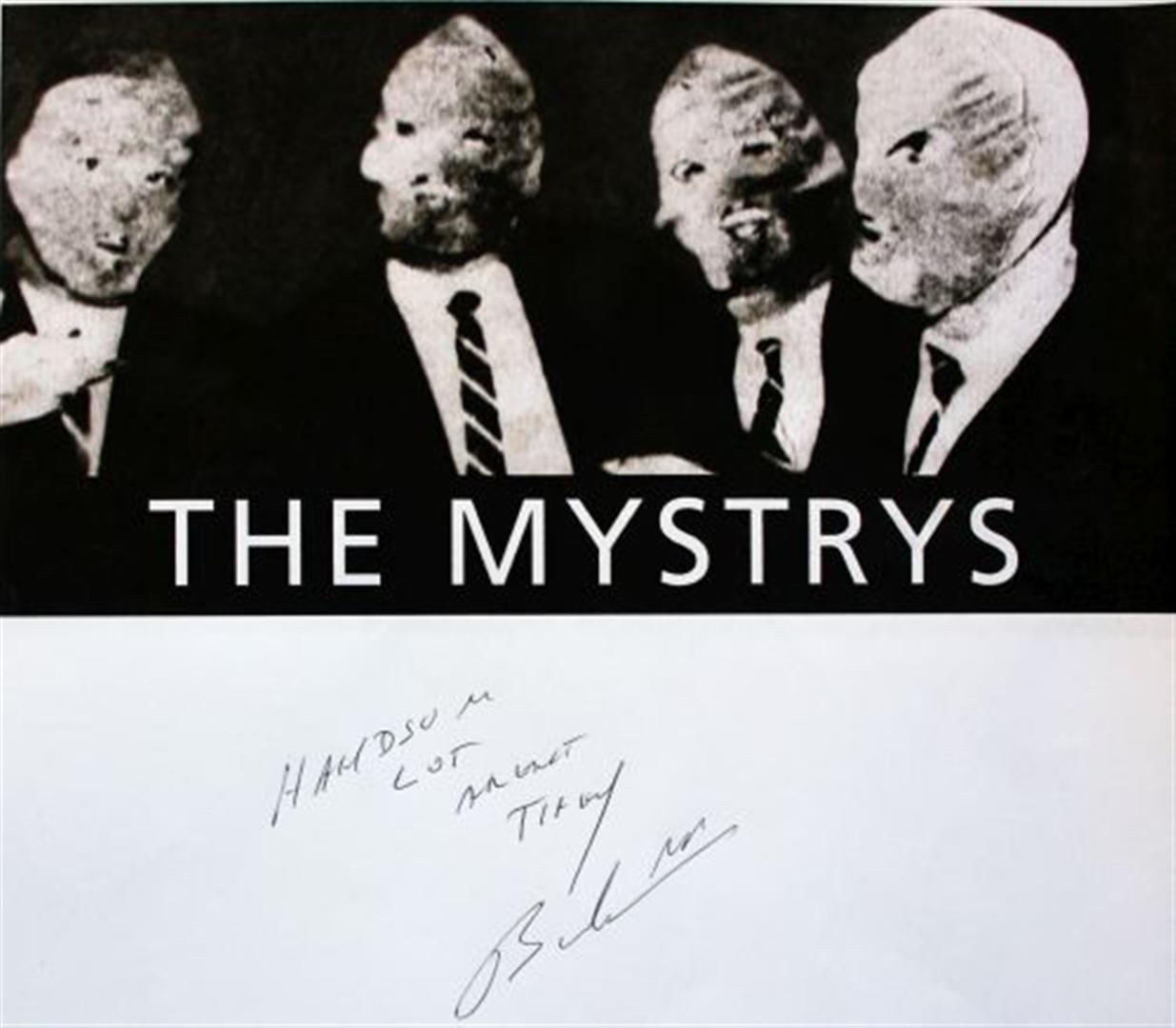
'Handsome lot aren't they?' - photo (and caption) provided by Bob King Crawford
Preceding masked acts like Los Straitjackets, The Mummies and TISM by decades, The Mystrys (and Michael Kopp) were well ahead of their time, distinguishing themselves from the pack in this way. But of course, the gimmick would’ve bombed if there hadn’t been genuine musical talent to support it.
THE SINGLE
In the beginning, things went well for The Mystrys. Caught up in the excitement and fun of being part of such an unusual project, they rehearsed solidly (and in secret) at a studio in Acland Street, St Kilda, working up their set and preparing for recording. The manic and mind-bending 'Witch Girl' was an obvious choice for the single; with the slower, more reflective 'Land of the Green Sun' slated for the B-side. “We recorded these two numbers at Armstrong’s with Roger Savage,” Charles recalls. Where else? Everyone from The Easybeats to MPD Ltd recorded at Armstrong’s during the 1960s: the cutting-edge South Melbourne studio was one of the country’s best. As was Roger Savage, the sound engineer. A recent arrival from England, Savage had worked with The Rolling Stones at Olympic Studios and was “a fantastic technician,” according to Charles — just the man to capture The Mystrys’ unique sound. (Savage later went on to forge an illustrious film career, doing sound for movies like Mad Max, Babe and Shine, and being nominated for an Oscar for his work on Moulin Rouge) “The sound just wasn’t available in those days, nobody was doing it. And Roger Savage…he had an eight-track recorder – the first eight-track that came into Australia. Or was it a 16-tracker? It was the first one that came into Australia, and we were about the first ones to record on it.” Ziggy elaborates: “We just recorded both tracks, first the instruments, then the voice tracks, more or less like it is done these days. The strange sounds on ‘Witch Girl’ were concocted by Roger Savage and added to the track.”
Having detailed the single’s finer points in my original Mystrys post, as well as in the Shindig! article, I won’t describe it here. Suffice it to say, there was nothing on the Australian charts at the time that sounded even remotely like it. (In fact, the song I think 'Witch Girl' most resembles — or, more to the point, which most resembles 'Witch Girl' — came two years later: “Journey to the Center of the Mind” by The Amboy Dukes.) Bob had big plans for the band’s recording career. “My idea was that we’d do what the Beatles did: we’d do an EP of four songs. Not the songs that were recorded — these were better and more commercial. We’d get the money from that and do two more straight afterwards … have all the stuff ready to go. Of course, the next thing I find was that Michael Kopp had chosen two other songs.” Although The Mystrys hadn’t yet played live and were an unknown quantity on the Melbourne scene, their single climbed the charts, first as a promo copy on Kopp’s own flash-in-the-pan label Orbit, then on the Festival-owned subsidiary Leedon. (Curiously, radio stations wouldn’t play its flipside, “because they said it was a protest song and the Vietnam War was on,” explains Charles. With its idealistic lyrics about food for nations to share, freedom being more than a word, and war not existing, it’s easy to see how broadcasters arrived at this conclusion. A shame, really, as this otherworldly number is quite a technicolour trip.) Meanwhile, the hype surrounding the band was building, helped along by appearances on teen music programs such as The Go!! Show and Kommotion, some hilarious media write-ups, and even a promotional music video dreamed up by Michael Kopp.
THE LOST FILM CLIP
“That film he made of The Mystrys was brilliant,” remembers Bob. Charles agrees. “It was just so innovative. Nobody was making videos in conjunction with their numbers in those days.” Frustratingly, a copy of the 'Witch Girl' video cannot be found. It's not on Youtube, and a search of the National Film and Sound Archive meets with a dead end. (One article from the time mentions it was sold to the BBC and CBS in Canada, although whether that’s truth or spin is anyone’s guess.) If Charles’s description is anything to go by, the clip was fab! “So we had this girl in a sports car behind a screen, and they had lights behind her, throwing an image onto the movie screen, and the cameras were actually shooting from the other side. And we were there playing 'Witch Girl'. She had a scarf around her neck, and a fan in the front was blowing the scarf, [making it look like] the scarf was wavering in the wind, you see. Then they went up on the ICI Building, and they dropped the scarf, and filmed it just floating away. And that was the end of the video." Of course, being almost 50 years ago, some details are a bit foggy. “I can’t remember where we filmed it — I’m sure it wasn’t at Acland St.” Ziggy’s memories are vaguer still. “I don’t even remember doing a video of 'Witch Girl'. I’d even forgotten about the Mystrys until I was reminded of the band 40 years later!”
BAND PROMOTION, KING CRAWFORD-STYLE
Michael Kopp may have come up with the masks, but besides this, he and Gerry “really had no idea what they wanted to do. It turned out I had to come up with the ideas,” Bob says. Taking the extraterrestrial concept and running with it, Bob spun a weird and wacky web of intrigue around the band, captivating and irritating journalists in equal measure. “It was just amazing. I mean, the media – anything I told them, they printed it. It was crazy!” he laughs.
Among his more creative stories are the following:
The Mystrys performed two inches off the ground, and didn’t have any shadows
The members were aliens from a planet outside the reach of Earth’s telescopes, whose journey to Earth took several years in a faster-than-the-speed-of-light spaceship (check out the previous post for details of their intergalactic pseudonyms)
The members were aged anywhere between 643 and 850 years old
They played 35 instruments between them
Due to contractual obligations, they ate, slept, showered and played with their hoods on, and didn’t even know what each other looked like
There was a fifth, invisible member, Finstar.
Another Crawford-generated rumour that fuelled much speculation was the one about The Mystrys being The Beatles on holiday in Australia!
Scrapbook clipping courtesy Ziggy Zapata
This excerpt from an interview with Bob and the band in TV Times (8 June 1966) gives an inkling of the snarkier journalistic reactions they provoked:
Mr King-Crawford broke in. “It may interest you to know,” he said, “that the boys have five bodyguards – to protect them from any fans who might want to tear off their face-pieces and discover their true identities.”“Aren’t the boys afraid,” I asked him, “that no-one will really CARE what their true identity is? What a let-down it would be for a mob of screaming teenage girls to rip off those masks and find five complete unknowns underneath.”
And then there were the publicity stunts. Pointing out a photo (below) in one of Bob’s scrapbooks, Charles comments: “See this one here? We’re in a pool at a motel named The California in Armadale. We turned up, obviously all dressed in masks and everything else –” “— I wanted to get a shot of the heads all just above the water –” explains Bob. “But somebody saw us walking in and they thought it was a hold-up. So they called the police.” says Charles. “Two divvie vans and a station wagon turned up with all these police in them.” Bob: “And they weren’t joking; they weren’t at all amused about it. I kept saying ‘they can’t take the masks off, their identities are a deadly secret!’” “That was funny,” laughs Charles. “It was just a little bit short of World War II,” Bob observes wryly.
In the pool at the California: I think I'd be mildly disturbed to come across this scene too! Courtesy Ziggy Zapata
Another time they were walking through the Southern Cross Hotel with their guitars, only for a guest to call the cops, convinced some kind of criminal act was unfolding. After all, felons always wander around in green velvet hoods while carrying musical instruments, right?
Salad, sir? The Mystrys having lunch at the Southern Cross, Courtesy Ziggy Zapata
LIVE AT LAST
By the time the band made their live debut at one of Brian de Courcy’s popular suburban ‘Mentone Mod’ dances, Mystrys mania was at fever pitch. “It took off,” Charles recalls. “Everyone wanted to know who we were, girls were trying to take the masks off … going crazy trying to find out who we were. It was really an exciting time.” Ziggy remembers another gig at Malvern Town Hall, where the group hid in a caravan organised by Michael Kopp to protect their anonymity while “groupies banged on the door” outside. “Michael wouldn’t let them near,” he says.
Scrapbook clipping courtesy Ziggy Zapata
“The whole concept worked so well, and they were choreographed,” Bob adds. That's right: not only did they wear masks and matching tailored suits, tell hilarious porkies about their identity and play pounding paranormal pop, but The Mystrys had choreographed stage moves into the bargain! It’s almost too much fabulosity for this brain to process! Curiously, before the band could consolidate on their popularity in Melbourne, Michael Kopp sent them on a tour of regional Victoria and South Australia. “We weren’t around long enough to say ‘OK we’re going to play regular gigs in Melbourne,’” Charles reflects. “And I’ve gotta be honest: the so-called management didn’t want to expose us too much. We were on The Go!! Show so we had that kind of exposure; we were interviewed; we played at a couple of places here but then we went on tour. And the tour lasted about four months. We were away for a long time.” In part 2: on tour with The Mystrys; the truth comes out; what happened next…