Showing posts with label 1966. Show all posts

Sunday, April 10, 2016

It came out of the sky: the Balwyn UFO

When you live perpetually behind the 8-ball like I seem to do, sometimes you’re a tad slow in acknowledging important dates and anniversaries. And this week, I’m kicking myself for not recognising the 50th anniversary of the Westall UFO sighting, which I covered in this blog some time ago. Apparently there were TV specials commemorating the occasion and everything. 

Anyway, one interesting thing to emerge from the latest flurry of media interest in this great unsolved Melbourne mystery is the fact that, just four days before the Westall incident, there was another sighting not too far away, in the skies of Balwyn. And a photo exists of the unidentified flying object in question.
Snapped in the Balwyn sky, April 2, 1966. Photograph: James Kibel
The photo above was snapped by a Melbourne businessman named James Kibel from the back garden of his parents’ house. He was there overseeing some renovations for them while they were on holiday and had gone into the garden to finish off the film in his old Polaroid camera when – as he explained in an interview soon afterwards with physicist and UFO researcher James McDonald – “I noticed a terrific flash on the garden as if, similar to the flash produced by a mirror in a heliograph type flash on the ground. It…enveloped half the garden, and gave me a fright.”

As the photo shows, the object appeared to be of polished metal. “It seemed to float down towards me,” Kibel described in another interview with Peter Norris for specialist publication Flying Saucer Review. “It resembled a big mushroom with the stalk pointing towards earth.


“Then it spun through a 180-degree angle on its vertical axis to take up the position in which I photographed it. It then turned slowly through another 180 degrees on its horizontal axis to bring the stalk part facing me.

“From an almost stationary position it shot off, northerly at terrific speed, accelerating to what seemed to be hundreds of miles an hour in seconds.”

It seems that Kibel has only recently allowed his real name to be used in relation to the sighting: at the time, he chose to remain anonymous for any interviews he did, well aware of the ridicule he’d attract from the sensible brigade. Being quite a high-profile Company Director, he didn’t want that kind of hassle.

Funnily enough, in the interview with Norris, he was given the alias James Brown!
Blimey indeed: the tone of this headline gives some indication why Kibel chose to stay anonymous
Once the object shot off out of sight, Kibel dashed around to the other side of the house, hoping that the carpenter who was there working on the renovation might have witnessed it too. Unfortunately, he’d been hard at work and missed the whole spectacle. However, he did see the Polaroid photo emerging from the camera, and later vouched that Kibel hadn’t doctored it in any way. 

Although the mysterious craft had been totally silent while Kibel was watching it, both men heard a great boom “like a plane breaking the sound barrier” as they waited for the photo to process. 


I want to believe…

Unlike Westall, where 200 people witnessed the flying saucer and corroborated each other’s accounts, nobody else came forward about the Balwyn UFO. Apparently Kibel did the rounds of the neighbours, but to no avail. Somehow they all missed it, reflective mirror-like flashes and all. In his interview with McDonald, Kibel shares his theory as to how and why this might be so:
“Well, it’s quite an exclusive residential area that’s mainly populated by older people. It’s not really unusual for people not to see these things I’d say but (…) but the other thing is too, that there could have been others that saw it but just wouldn’t say anything about it. I think this is a good possibility. I’d feel quite certain someone else must have seen it, but whether they said anything about it is another thing.” (For a complete transcription of the interview and a hell of a lot more detail about the sighting, go here.)
As someone who used to sit on her back porch at night, trying to send telepathic communications to outer space in the hope of making contact with extraterrestrial life forms, I’m possibly less sceptical than some when it comes to reports of UFO sightings. And I see no reason to doubt the testimonies of those who were at Westall that fateful day in April 1966. 


But one aspect of the Balwyn sighting strikes me as suspicious — or at least conveniently coincidental. Not only was James Kibel a member of the Victorian Flying Saucer Research Society, but this was not the first time he’d seen an unidentified flying saucer! I mean, seriously: what are the chances? Did he conjure up the thing through his sheer will to believe? Or was the photo staged with a strategically thrown light shade? (It wouldn’t be the first time)

I’d like to think not. And certainly, Mr Kibel’s interviews all seem extremely consistent, considered, and matter of fact. 

Plus there’s this: a photo of a craft sighted flying over the Rocky Mountains, southwest of Provo, Utah, in July 1966. 
Anyone else see a certain resemblance to the Balwyn UFO? Not identical by any means: more like two models of vehicle from the same manufacturer. In the same way as, say, an HD looks like an EH, but obviously isn’t one.

Or it could just be a light shade hurled into the air...

Thursday, January 8, 2015

Time-tripping in the 1966 Lincoln Continental that belonged to Ford Australia’s head honcho

So apparently the GM of Ford Australia in the 1960s drove a 1966 Lincoln Continental – a right-hand drive model that was hand-built shipped over from the US especially for him. There doesn't appear to be any documented evidence to support this claim – but trust me, it’s the truth. How do I know? Well, because I was a passenger in this very car over the Christmas break!

And here it is. Holy Yank tanks, Batman, would you get an eyeful of that?
Stylin'.
Check out that rectangular beastliness: if that doesn’t look 70s, I don’t know what does. But no, this rumbling road-hog is definitely from 1966. Supposedly the 60s Lincolns were a deliberate departure from the fins and chrome-plated flamboyance of the 50s models.

Can’t you just imagine this thing cruising the mean streets of Geelong all those years ago? Personally I find it a bit odd that the top dog of Ford Australia didn’t support the national product by driving a Falcon XP, but hey, when you’re the boss, you can do what you damn well please. 


Imagine parallel parking this thing!
The Continental is currently owned by a Wollongong-based motoring enthusiast named Rob (let's just say it's one of his many two- and four-wheeled vehicles). Rob bought it off an old bloke called Kevin in Bathurst, who told him that Mr Ford Australia drove it until 1968 or 1969. Then he sold it to his mate, who subsequently sold it to Kev in 1981. But because the car's history started in 1960s Gee-troit, it more than qualifies for this blog.

Effortlessly outshining the ugly modern cars in the background
So what was it like to ride in? Smooooth, baby. We were driving through downtown Albury so there was no opportunity for hooning, but the sense of coiled power just waiting to be unleashed was palpable. Rob says the fastest he’s driven it was about 110 miles an hour:
"Whilst is it still amazingly smooth at that speed (approx 170kph), you are aware that you're moving a 5.6-metre and 2.5-ton object with only 1966 combination disk (front)/drum (rear) brakes to avoid Armageddon. I lack that bravery, I must say."

Inside, it’s super-flash, with all sorts of controls and fancy details. Some of them may be commonplace today but would've seemed positively space-age back in 1966.

Dash detail
Take a deep breath and repeat after me: ashtrays and cigarette lighters for every passenger (and the driver, of course), eight-way electric seat settings, cruise control, an eight-track player (Cosmo’s Factory by CCR was our motoring soundtrack) and separate AM/FM radio (with a foot switch to change the station!), air con and power windows (including power quarter vents). If you’d asked me whether power windows even existed in 60s Australia, I would’ve said hell no.


Inside door detail 
But wait, there's more! (Minimalism clearly was not a word in Lincoln's vocabulary).
Individual interior light switches for each passenger, vacuum-operated door locks on the driver's side to lock your passengers in, a foot-operated handbrake, hazard lights, variable-speed windscreen wipers, automatic boot release from inside the car... all topped off by a gas-guzzling, 462 cubic inch (7.6L) engine that Rob admits is "obscene and quasi-unspeakable by today's standards! Fuel consumption? Of no significance in 1966!"

No wonder the Lincoln Continental was the car preferred by US Presidents (although as Rob points out, "it didn't do JFK any favours -- a roof may have helped.")

Suicidal!
It was also a hit among US mobsters, thanks to probably its most noteworthy feature: rear-hinged ‘suicide’ doors. Yep, the back doors open backwards! Rob explains that suicide doors "allowed their dames to gracefully alight from the vehicle when draped in classy evening frocks (which was pretty much all the time). This, along with the car's vacuum locks and a trunk big enough to fit three bodies made it a firm gangster favourite."

Could that be why Ford Australia didn’t introduce them into any of their locally manufactured vehicles?

Wednesday, November 19, 2014

Melbourne song of the month: “Witch Girl”/The Mystrys (June 1966)

Australia’s one-hit wonder tradition is not what you’d call illustrious. Think about it: “Nice Legs, Shame About the Face” by Dave & the Derros … “Bop Girl” by Pat Wilson … “I’m an Individual” by Mark Jacko Jackson … Countless singles by former soap stars. But there is one exception to this rule: the magical and mind-bending “Witch Girl” by The Mystrys. 

This is one one-hit wonder that makes you wonder what might have been.

Sure, it bears all the hallmarks of a novelty record — bursts of spacey keyboard, eerie female backing vocals, burbling cauldron effects, Hammer-Horror lyrics — but “Witch Girl,” transcends these details with some fine musicianship and an atmospheric production Joe Meek would’ve been proud of.
Mysterious, masked and mind-blowing: The Mystrys. Photo: http://www.ziggy.com.au/mystrys.htm
After a crazy intro that conjures up images of dank basement torture chambers, the song hits a cracking stride, propelled along by rollicking drums, chugging guitar and impassioned vocals, until it ends suddenly around the two-minute mark. 


Those of you paying attention might’ve noticed that the lead break is a bit anti-climactic compared to the song’s otherwise lavish, multifaceted sound —  this was an unfortunate case of songwriter Bob King Crawford's ambitions out-stripping the technical possibilities of the day. Even in South Melbourne’s state-of-the-art Armstrong Studios, with renowned recording engineer Roger Savage at the controls, Crawford's vision was simply too far out… 

Interviewed for The Mystrys' chapter in Wild About You! lead guitarist Ziggy Zapata recalls:
"I was extremely fast on guitar even in those days and I was going to go crazy [in the solo] and do 98 notes to the bar, but Bob said, 'Keep the guitar really simple because we're going to add some special effects [over it] afterwards.' ...a lot of the effects I expected didn't happen because they had a few studio glitches. So the guitar solo's not very inspiring at all."

“Witch Girl” was supposed to be the first of many Mystrys singles penned by Bob King Crawford, a well-known local music industry identity of the time. Apparently he had a whole suite of songs ready for the group to record, all similarly weird and whacky in theme — but all now lost in the mists of time. If “Witch Girl” is anything to go by, we’ve missed out big time.

The Mystrys: truth is stranger than fiction


So why were The Mystrys so short-lived? That certainly wasn't the intention of their manager Michael Kopp, a dodgy impresario type who conceived the band as an Australian rival to The Beatles and The Stones, destined for superstardom. Like one of those cartoon characters with dollar bills flashing in his eyes, Kopp was itching to cash in on the booming pop music scene.

After catching singing bass-player Charlie Bayliss performing in St Kilda with his group The Untouchables, Kopp approached him with his big idea; Bayliss then recruited the rest of the band, including the aforementioned Zapata, who was also in The Untouchables.
A promo shot of The Mystrys striking fear into the hearts of songwriter Bob King Crawford, manager Michael Kopp and financial backer Buff Parry. Taken from http://www.ziggy.com.au/showbiz.htm
As the photos in this post attest, The Mystrys weren’t like other bands. Preceding Los Straitjackets and The Mummies by decades, they disguised their identities by wearing creepy green velvet hoods over their heads, adopting outlandish alien names and claiming to be from another galaxy. LOVE IT!!!


If that weren’t enough, Kopp also dreamed up the notion of a fifth, invisible member. Yep, he’s the one you can’t see in any of the photos.

While Zapata considers the whole gimmick to be “really stupid”, he found the hoods to be particularly irritating. He writes on his website:
“Apart from being extremely uncomfortable, these hoods totally negated any chance of rock fans being attracted by the looks of the band members, which was the most important factor for anybody wishing to achieve pop stardom.”
A shame, really, as they weren’t bad-looking boys (OK, so they weren't heart-stopping spunks either):
Kevin, Ziggy and Charlie,with some of the girls from The Kontacts, the band they toured with.
Check out Zapata’s website for a far more in-depth — and often hilarious! —history of the band than I’m able to give here.


A premature end


Released first as a preview copy for media through Michael Kopp’s Orbit label, and then more widely on Leedon, “Witch Girl” was a hit, just like Kopp planned. But before The Mystrys could capitalise on the single's success, Kopp vanished off the face of the earth. Turns out he had a nasty habit of writing bouncy cheques, and since he’d paid for most of the band’s expenses by cheque, things eventually got too hot for him.

The Mystrys, on tour in Adelaide at the time, decided it was time to pull the plug. As Zapata explains sadly, “There did not seem to be much of a future for a band that was a complete mystery to its targeted fan base.”  

Saturday, September 13, 2014

Westall '66: an unsolved Melburnian mystery

Little green men, alien abductions, extraterrestrials living among us …all too often, the notion of life from other planets loses credibility because of the whole whacked-out Weekly World News angle. Which can make it hard for folks who experience genuine intergalactic encounters to be taken seriously. But when 200 people witness a UFO only to get shut down by authorities and told it was just a stray weather balloon… well! That’s even more absurd than the idea of Hilary Clinton adopting a baby alien.
 Yet (joking aside) this is what happened to staff, students and neighbours of Westall High School in Melbourne’s southeast back in April 1966. At around 11 o’clock on an apparently normal Wednesday morning, their reality was turned inside out by the appearance of a silver disc hovering and then landing just behind a line of pine trees in nearby Grange Reserve. It eventually shot off at jaw-dropping speed, but not before some kids were able to run over and get a closer look.

So what was it? Some 48 years after the event, this remains a mystery. Judging by the recollections of some of the witnesses in the documentary Westall '66: A Suburban UFO Mystery, it sure as hell wasn’t a weather balloon or experimental aircraft like they were told. But they soon realised that if they talked about it, they’d be considered crazy.

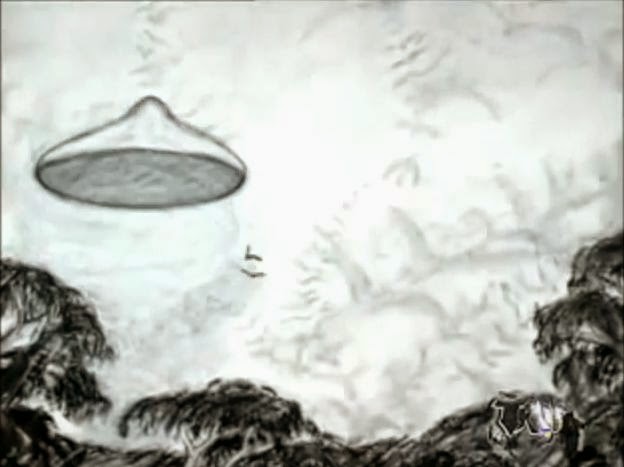
These drawings are stills from the evocative animated sequences by artist Lee Whitmore that illustrate some of the recollections recounted in the documentary Westall '66: A Suburban UFO Mystery
Immediately after the event, the school principal called an assembly, where he told the students that all they'd seen was a weather balloon. He banned them from speaking to the journalists that had congregated outside (although some did) – and as a result, there wasn’t a lot of media coverage. Channel 9 news reported on it at the time, but the film has since gone missing.

Local newspaper The Dandenong Journal ran a couple of stories, but never got to the bottom of it:
"The Dandenong Journal - 1966 14th Apr - page 1" by Photo or scan of newspaper page, and intellectual property owned by The Herald and Weekly Times Ltd, News_Corporation. Licensed under Fair use of copyrighted material in the context of The Herald and Weekly Times Ltd via Wikipedia -

Not wanting to come across like a crackpot is a powerful motivator to shut your trap for most people; even more so for adolescents, I guess, at that stage of life where you just want to fit in. But even teachers felt the pressure. One was visited by some mysterious government types who told him that if he didn’t keep quiet, they’d spread rumours that he was an alcoholic. Another, who’d taken photos of the flying saucer, had her camera confiscated.

Westall '66 gives the witnesses a chance to speak about the incident without fear of judgement. Not all the stories are consistent: some mention seeing two flying saucers; others remember the UFO playing a game of cat and mouse with a group of small airplanes. Some recall getting so close to the craft that they could feel the heat emanating from it. Others remember a large circular imprint of flattened grass where the object had landed. There's even talk of a girl called Tania who got to Grange Reserve first, fainted, was taken off in an ambulance and never seen again.


Cover illustration from The Clayton Calendar, a school publication from the time
In the days that followed, students and other locals saw official-looking men in suits at the site of the UFO landing and at the school, but nobody knows who they were associated with. The Australian military? The US military? ASIO? Researchers into the event have come up against a brick wall in terms of archived documents or reports; even the RAAF’s records of UFOs for 1966 don’t mention Westall.

Fascinating stuff. 
There is now an extraterrestrial-themed kids' playground at The Grange, complete with flying saucer! (Pic: Weekend Notes, Melbourne)
And the theories keep coming. Just last month in The Herald Sun, there was an article claiming that the silver disc seen by the Westall students all those years ago was in fact a special silver balloon used to test radiation levels post-Maralinga, which had blown off-course after being launched from Mildura.

While I couldn’t possibly do justice to the quirks and convolutions of this confounding slice of Melburnian history in one blog post, I can definitely recommend the documentary, following researcher Shane Ryan's quest to uncover the truth. Spoiler alert: he doesn't.
These witnesses are definitely not crazy. The official cover-up is like a plot from the X-Files. And I simply can’t get Creedence Clearwater Revival’s “It Came Out of the Sky” out of my head…